Electromagnetic fields (EMFs)
“Electromagnetic fields” is a common term which encompasses different types of fields in the electromagnetic domain, including 1) electric fields, 2) magnetic fields and 3) electromagnetic fields. All the afore mentioned terms may be encountered and these mean different types of fields. All field types require attention from the health and safety perspective as these are physical quantities which may induce physical effects. Electromagnetic fields are also referred to as “electromagnetic waves”, “electromagnetic radiation”, or more specifically as “radiowaves”, “radiofrequency fields”, “radiofrequency radiation”, “microwaves” etc.
The field is like the ocean
The field of the electromagnetic domain is everywhere – in the air, space, inside the ground and within us. For imagination purposes, this field could be viewed as an ocean which extends to every place. This field can be excited, which generate waves that travel across the field. This is much like waving a hand up and down in the water. The larger the amplitude of waving the hand, the higher waves are greated, hence the further these travel. Multiple waves occupy the field simultaneously – there are longer waves and shorter waves travel on top of these.
EMF properties
Electromagnetic fields’ have several characteristics/properties. Different types of electromagnetic signals travel across the field. These may include different types of characteristics, but the most important ones are 1) frequency and 2) amplitude/power density. Also there are properties such as 3) direction, 4) polarization, 5) waveform. Some electromagnetic signals may include additional properties, such as 6) modulation, 7) bandwidth and 8) periodicity. The combination of the afore mentioned properties makes up each discrete electromagnetic signal which propagates throughout the field. All of these properties may play a role in health and safety. Table 1 below summarizes these different properties of electromagnetic signals.
Table 1. The list of electromagnetic field/signal properties
| Property | Unit | Examples |
| frequency | Hertz (Hz) | describes the number of oscillations in a second; slow oscillations make up the low frequencies and faster oscillations create high frequencies |
| amplitude, power density | e.g. nanoTeslas (nT), Volts per meter (V/m), microWatts per sq m (μW/m²) or other | in layman’s terms – how strong is the field. The stronger the field, the more energy it has to create a physical effect, e.g. biophysical effect like a health effect. Adverse health and safety effects are thought to be avoided by establishing safety limits in terms of field amplitude or power density. |
| direction | – | all electromagnetic fields travel away from the point of source, this gives them a direction; human exposure may happen from multiple directions, as there are multiple sources of these signals, but usually the exposure comes from one main direction |
| polarization | horizontal, vertical, circular or mixed | describes the axis by which the oscillations in the field are created and travel – usually either vertical or horizontal; by analogy of the ocean, the polarization indicates, by which orientation the waves hit the body; polarization is also good to know, when attempting to stop the field by means of shielding or other means |
| waveform | sine, square, pulse or other | the equipment generating the signal has a specific waveform; square waves are thought to be more biologically effective than sine waves; nature creates only sine waves |
| modulation | Hertz (Hz) | In example of a radio station, a carrier wave carries a signal wave, whereas the signal must be at a lower frequency than a carrier wave; in biological effects’ studies, modulation is often seen as a main actor that induces a biological effect |
| bandwidth | Hertz (Hz) | in signal transmissions, bandwidth indicates, how much data is being transmitted; 4G mobile telephony protocol uses 20 MHz bandwidth, which means that there are actually many discrete frequencies in the air; the wider the bandwidth, the more single frequencies are transmitted |
| periodicity | duty cycle as a percentage or a ratio | describes the percent time when a signal is active; some signals are constantly on, e.g. FM radio transmitters; some signals are intermittent, e.g. radar sweeps. |

Frequencies
Frequency is an inherent aspect of electromagnetic fields. All EMFs are located somewhere in the frequency spectrum. For example, FM radio stations reside in the range of 88-107 MegaHertz (MHz) and by knowing your favorite station’s frequency, one can dial the radio receiver’s frequency knob to the right frequency, say 100.0 MHz. The latter means, that oscillations in the field occur one hundred million times a second (100 000 000 per sec). This is really fast physical movement which is inconspicuous from the human perspective. Lower frequencies are for example power frequencies, e.g. 50 Hz in Europe and 60 Hz in Americas. This means that oscillations occur 50 or 60 times a second.

9 types of electromagnetic fields
“Electromagnetic fields” is a common term which encompasses different types of fields, including 1) electric fields, 2) magnetic fields and 3) electromagnetic fields – at different frequency groups. In our everyday lives, we are exposed to most of these field types. The closer we are to the technology, the closer we are to the field sources, and the more higher exposure we get.
It is important to identify the type of EMF, because it tells us three important things,
- what is the source of pollution,
- how may it affect us, and
- how can we stop this – what measures are available for mitigating the field.
Natural fields
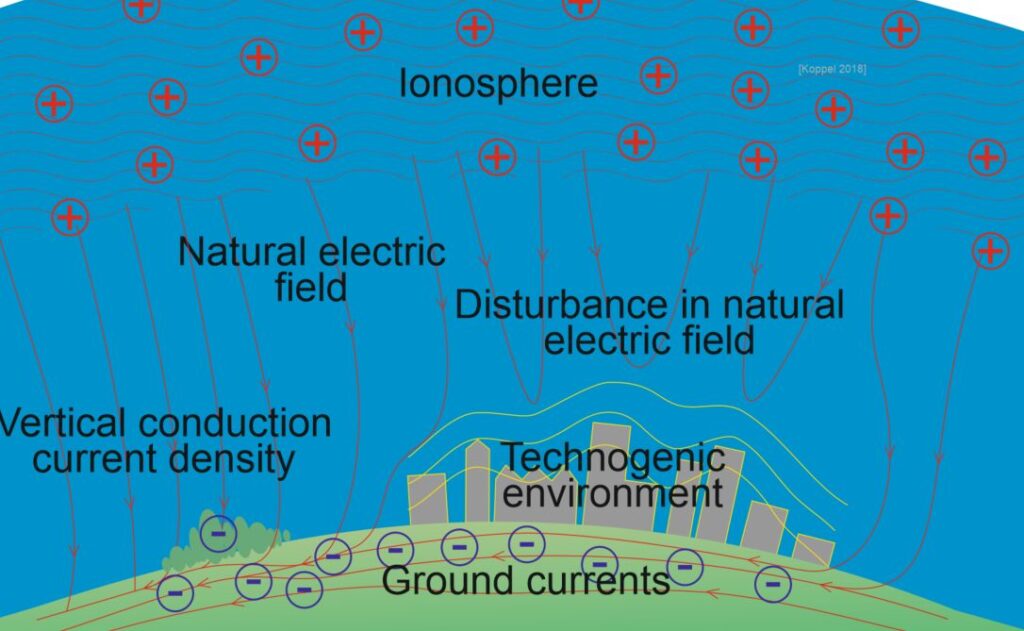
In the living environment, there are both natural EMFs and man-made EMFs. Most natural EMFs are considered safe, as these have accompanied human evolution on this planets for hundreds of thousands of years. This means, we have evolved to tolerate such fields and even according to some research – to be dependent on these natural fields. Natural fields emanate from inside the Earth, from the atmosphere, and from the space. Natural fields are created also by physical processes and even biological processes on the surface of Earth. For example, all the living organisms are connected to a natural field through atmospheric currents, which is a flow of electricity between the ground and the ionosphere. This mechanism is tightly coupled into the ground type and conductivity, telluric currents (ground currents), air ions and other environmental health factors of animal and plant life.

Transmission, reflection, absorption
Different types of fields (out of afore mentioned nine types) can be stopped by different means. It is important to know the type of field and the direction on travel, so we can devise measures of mitigation, if needed. Depending on the construction material, and the field type, and the field strength, the travelling field is either 1) transmitted through the material, 2) reflected back from the material or 3) absorbed by the material. When the aim is to avoid inhabitants exposure to the field, evidently we aim for the latter two options – blocking the field by reflection or absorption. Shielding is a wide term that could refer to both reflecting and absorption.

Dirty electricity
Dirty electricity is considered intermediate frequency current in the range of approx. 2-400kHz in the electrical grid and in electrical equipment. It can be measured in two ways: 1) as a current moving in electric wires and 2) as an electromagnetic field in the working environment. Pure, sinusoidal electricity (50 or 60 Hz electric power) is polluted by devices that contain components operating at intermediate frequencies, such as switching mode power supplies, transistors. Almost all modern devices, including energy-efficient devices, are powered by such built-in or external adapters. Intermediate frequency adapters generate mid-frequency noise and harmonics in the building’s electrical system (wiring). This is what created dirty electricity. The mains frequency (50 or 60 Hz) is the carrier signal, and the high-frequency oscillation “travels” on to of that.

Exposure
Exposure means being in contact with the electromagnetic field. As the field travels through the air and even through the trees, buildings etc. – we are always exposed to some amounts of EMFs. The closer the person is to the source, the higher the exposure. The more powerful is the source output radiation, the higher the exposure. This can be compared to being exposed to a tanning bed radiation: 1) the closer we are to the tanning bed UV lamps, the quicker we get a tan; 2) more powerful UV lamps give us a tan quicker. Everybody understand that tanning time should be strictly controlled, in order to avoid sunburns, which is an adverse health effect. Some EMF research emphasizes that at least some of the health effects are dependend on cumulative lifetime exposure. This can be compared to the bucket, that gets filled at some point of time, after which the body has had enough for the symptoms to appear.
Risk groups
Adolescents, pregnant women, people with medical implants are legally considered as EMF risk groups in the European Union. These groups need to have more safe EMF conditions, as they are considered vulnerable to the adverse effects. Adolescents are considered vulnerable, because the underaged body, including the immune system is yet to fully develop. Any physical factor, when overly exposed, may affect the normal development process, which may result in underdeveloped immune system or other abnormalities. The same caution is applied to the fetuses of pregnant women, as any physical excessive factor, may have immense impact on fetuses development. People with medical implants are in danger from high level EMFs as these may cause the malfunction of their implants and endanger their health and life. Chronically ill people could be added to this list, because of their weakened immune system, that normally would deal with repairing damage to the body from physical hazards.
Electrostress
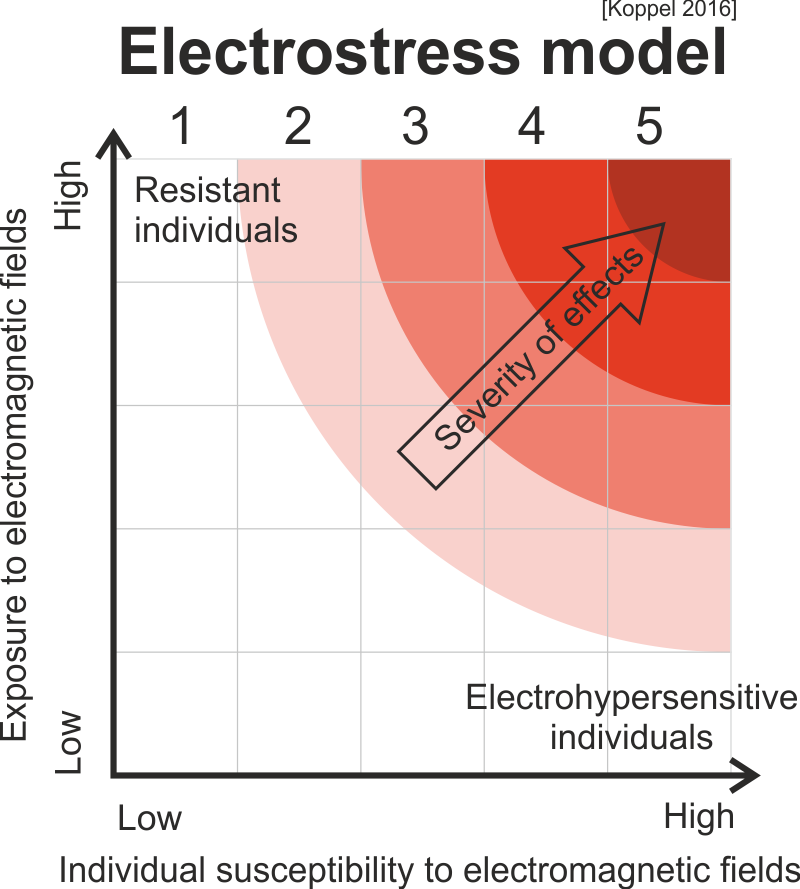
When a person who develops one or more symptoms, due to the excessive exposure to the electromagnetic fields – the person is considered to be suffering from electrostress. If the source of electromagnetic pollution is not removed, electrostress can last for a long time (several months or years). Symptoms may worsen and become chronic, whereas electrosensitivity is developed. Suffering from stress should be taken seriously, and the causes should be identified. Electromagnetic pollution should be considered as a possible factor, when no other common cause could be linked to the increasing levels of stress. Some people are more sensitivity to EMFs, some are more resilient.
Electrosensitivity
Electrosensitivity is a form of physical sensitivity and should not be considered as an illness. All other known physical, chemical and biological environmental risk factors are known to cause sensitivity – so is the case for electromagnetic pollution. Most people that end up with electrosensitivity, say they were perfectly fine few years ago, but then noticed becoming increasingly unwell around the EMF sources. Some people may be sensitive to microwaves, others to power frequency electric fields. The sensitivity likely develops due to recurring exposure to the same type of field, which the body gets sensitized to. Sensitivity means, that the body detects the exposure to the EMF and then react by expressing one or more symptoms. This is why, sensitivity should not be considered as an ilnness, but a way the body signals you about being exposed to a risk factor, so you could take steps to evacuate from the situation.
There are EMF sources we cannot control
In the modern city environment a multitude of EMFs surround us. Those fields are created by the utilities, the infrastructure, and the consumer devices. Much of the EMF exposure is controlled by the consumer itself, but some of the exposure sources are outside of the control of said person. These outside sources are located in the immidiate vicinity and might be there thanks to the neighbors, nearby industries, infrastructure or utilities. Often, there is little we can to do against such sources, hence the exposure at this location seems inevitable. On the other hand, when the source is undery your control, it’s reasonable to minimize the exposure whenever and wherever possible.
Biological effects and adverse health effects
Every physical factor evokes an biological effect however minute, therefore, not all biological effects are health effects. Some physitherapy modalities use strong EMFs intentionally, to evoke a certain biological effect, for the health benefit of the body. In therapy, the dosage is closely set, so it would be not too much for the body to handle. When the exposure to the agent becomes uncontrolled, excessive and too much for the body to handle – we talk of adverse health effects.
Short-term exposure and chronic exposure
To fully understand the scope and the effect EMF can have on human body, we must distinguish between short and long-term exposure. Short-term exposure is measured in seconds and minutes. Long-term exposure is measured in hours, days and even years. When the body is exposed to the electromagnetic field under recurring basis, the body may not be able to fully recover and return and return to normal homeostasis. Such effects may then accumulate and have worsening impact on health untill the cause for the exposure is adequately adressed.