In Earth’s magnetic field, if an iron construction element is magnetized, the nature of the magnetic field it generates will be influenced by the alignment of its magnetic domains with the Earth’s magnetic field.
Iron objects becoming magnetized
When an iron pillar is exposed to Earth’s magnetic field, it can become magnetized. This means that the magnetic domains within the iron (small regions where the magnetic moments of atoms are aligned) tend to align with Earth’s magnetic field. When iron is being cast and crystallizing, the process of becoming magnetized in the presence of Earth’s magnetic field involves the alignment of magnetic domains during the cooling and solidification stages. While the iron is cooling and the crystals are forming, the presence of Earth’s magnetic field can influence the alignment of these magnetic domains. Earth’s magnetic field provides an external magnetic field that can affect the orientation of the magnetic moments within the forming domains.
The iron pillar itself will have a North and a South magnetic pole. The North pole of the magnetized pillar will point towards the magnetic South pole of the Earth (which is geographically near the North Pole) because opposite magnetic poles attract.
Deviation in magnetic field
The presence of the magnetized iron pillar will locally alter the magnetic field. The magnetic field will be stronger because the field lines from the North pole of the pillar will add to the Earth’s magnetic field lines. This means an increase in the magnetic field strength in this region.
Similarly, the magnetic field lines from the South pole of the pillar will also add to the Earth’s magnetic field lines, resulting in an increase in the magnetic field strength in this region as well.
Thus, the magnetized iron pillar creates its own magnetic field that superimposes on the Earth’s magnetic field. Near both the North and South poles of the pillar, the local magnetic field strength increases because the pillar’s magnetic field lines add to those of the Earth.
It’s important to note that the pillar’s North and South poles refer to its own magnetic poles and not to the geographical poles. The key takeaway is that the magnetized pillar enhances the local magnetic field strength at both its poles
The observation that the static magnetic field near an iron pillar sometimes increases and sometimes decreases, being half of the Earth’s magnetic field, can be explained by several factors related to the behavior of magnetic fields and the properties of the iron pillar.
Magnetic field superposition
The magnetic field at any point near the iron pillar is the vector sum of the Earth’s magnetic field and the magnetic field produced by the pillar.
If the iron pillar’s magnetic field partially cancels out the Earth’s magnetic field at certain points, you might measure a decreased field strength. This happens when the field lines from the pillar oppose the Earth’s field lines.
Close to the North pole of the pillar, the field lines of the pillar add to the Earth’s field lines, leading to an increased local magnetic field.
Close to the South pole of the pillar, a similar addition occurs, but depending on the relative orientation and strength of the fields, there can be areas where the field lines partially cancel each other out.
Temporal variations
The Earth’s magnetic field itself is not completely static; it has temporal variations. Although these are usually slow and subtle, they might contribute to small changes in the measured field.
Influence of nearby objects
Other ferromagnetic objects or sources of magnetic fields in the vicinity can also influence the measurements, creating local perturbations in the magnetic field.

Figure 1. Earth’s magnetic field is composed of field strength lines
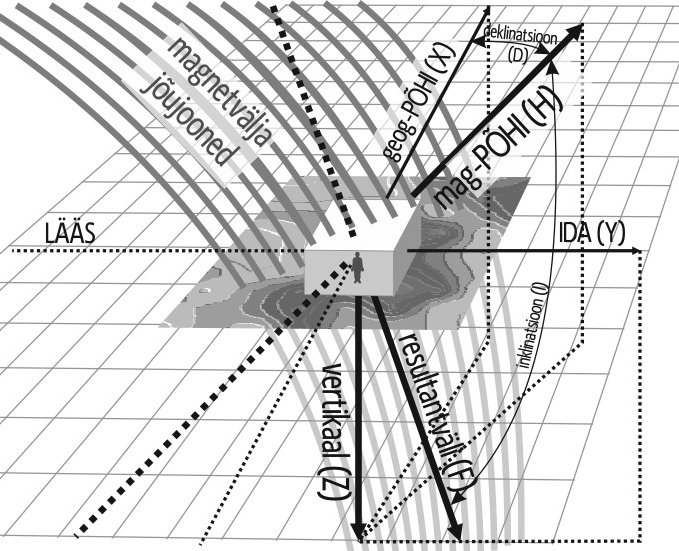
Figure 2. Earth’s magnetic field inclination, declination and axis

Figure 3. Ferromagnetic metals such as iron constructional elements focus Earth’s magnetic field around it

Figure 4. Non-magnetic materials, such as concrete, wood etc. do not alter the magnetic field leaving it homogeneous.
0 Comments